
Grover: From Leader Teleop to Closed-Loop Cube Pick on a SO-101 Arm
Written by Zackary Frazier, posted on
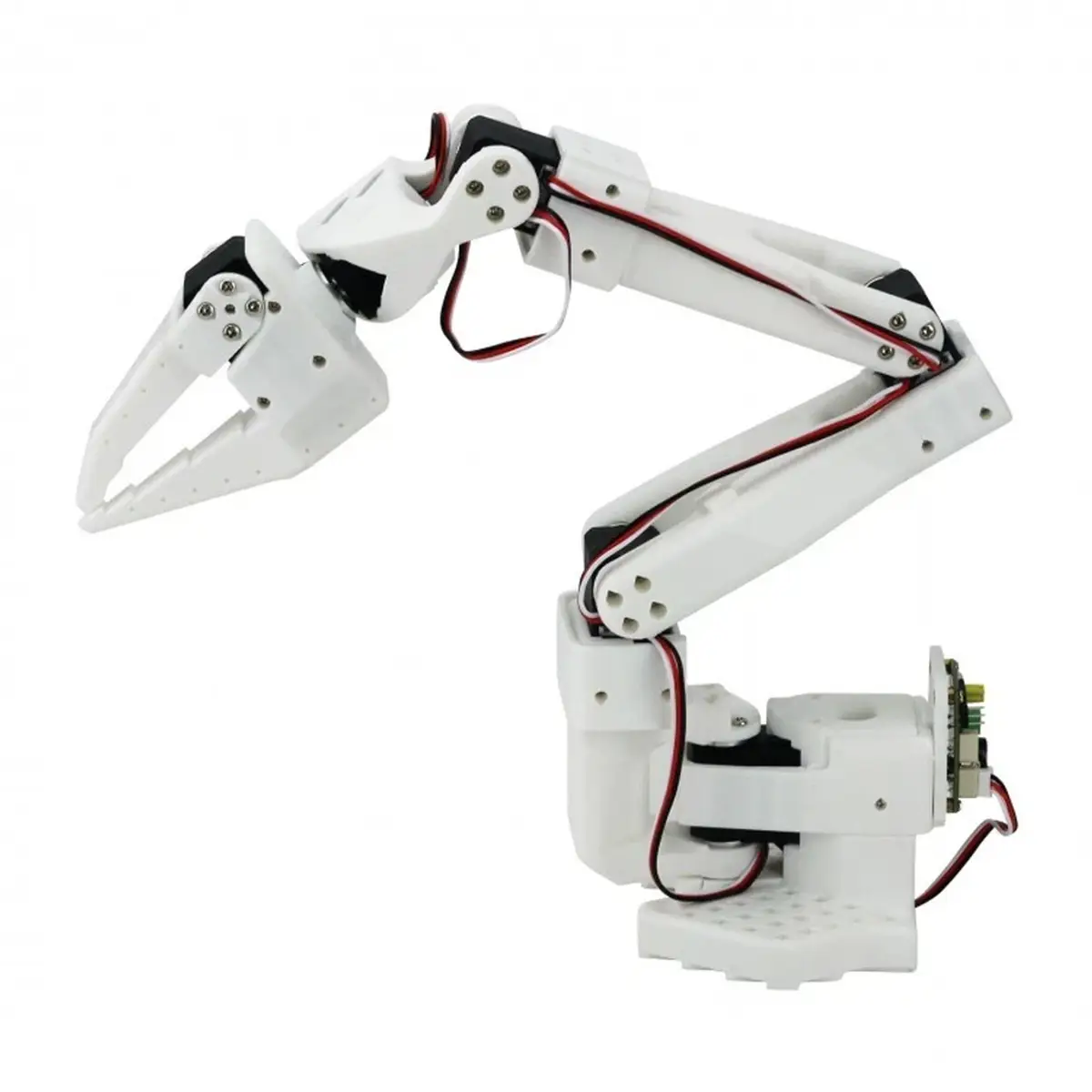
I wanted an SO-101 arm that could watch a cube through its own wrist camera, decide where to grab it, and actually close the loop — no scripted coordinates, no separate rig for teleop versus inference. That system is Grover: a SO-101 follower arm (gi_jane) with a wrist-mounted Intel RealSense D405, driven by ROS 2 Jazzy and MoveIt 2, running a LeRobot ACT policy trained entirely from my own leader-teleop demonstrations.
The full pipeline — bringup, teleop, detection, planning, and imitation learning — lives in one workspace, and on a timed set of trials it closed the loop autonomously 8 out of 10 times (80%).
What I Built
Grover takes a hardware pair — a SO-101 leader (gi_joe) for teleop and a SO-101 follower (gi_jane) for execution — and wires them into a single ROS 2 Jazzy workspace alongside MoveIt 2 and LeRobot. The arm is commanded in joint position through ros2_control, and the wrist RGB feed doubles as both the perception input for cube detection and the observation stream for the learned policy.
The end-to-end sequence looks like this:
- Teleoperate the leader arm to collect demonstrations of "pick up the cube."
- Train an Action Chunking Transformer (ACT) policy on wrist RGB + joint state.
- Detect the cube autonomously using HSV segmentation plus aligned depth from the D405.
- Hover MoveIt above the detected cube, holding wrist orientation.
- Hand off to ACT for the final ~12 seconds of closed-loop grasping.
- Return home, ready for the next cycle.
flowchart TB
  subgraph hw [Hardware]
    leader[SO-101 leader gi_joe]
    follower[SO-101 follower gi_jane]
    d405[D405 wrist]
  end

  subgraph bringup [so101_bringup]
    feetech[Feetech ros2_control]
    camNode[realsense2_camera d405_wrist]
    moveit[move_group + servo]
    fcc[fcc_trajectory_adapter]
    feetech --> follower
    camNode --> d405
    moveit --> fcc
    fcc --> feetech
  end

  subgraph scripts [Python scripts]
    teleop[lerobot-teleop / record]
    detect[detect_red_cube]
    hover[hover_above_cube / grasp_cube]
    act[ACT policy]
  end

  leader --> teleop
  teleop -->|arm_controller/commands| feetech
  camNode -->|color + aligned depth| detect
  detect -->|hover_pose| hover
  hover --> moveit
  camNode -->|RGB| act
  act -->|joint goals| feetech
The Technical Stack
- Hardware: SO-101 leader/follower pair on a Feetech STS3215 bus, wrist-mounted Intel RealSense D405.
- Middleware: ROS 2 Jazzy,
ros2_control(ForwardCommandController), MoveIt 2. - Learning: LeRobot 0.5.1, ACT policy trained on wrist RGB (640×480 @ 30 Hz) + joint state — no depth in training.
- Dataset: 86 leader-teleop episodes, 18,279 frames, published on Hugging Face.
- Detection: HSV segmentation + aligned depth for real-time cube localization.
The Hard Part: Making ROS and LeRobot Share a Camera
The single biggest engineering constraint on this project turned out to be mundane: a USB camera can only be opened by one process at a time. Both the ROS RealSense driver and LeRobot's own camera interface wanted the D405 for different reasons — ROS for live cube detection during autonomous runs, LeRobot for recording and evaluation. Opening both at once fails with VIDIOC_S_FMT.
Rather than duplicate the camera stack or bolt on a broker, I made ownership a launch-time decision:
enable_d405:=true— ROS'srealsense2_cameraowns the device (detect / hover / autonomous grasp).enable_d405:=false— LeRobot'sintelrealsensecamera owns the device (record / eval).
When ROS owns the camera and the ACT policy still needs frames, it doesn't reopen the USB device. Instead, scripts/ros_image_camera.py implements LeRobot's Camera interface but subscribes to the existing ROS topic (/d405_wrist/color/image_raw) over SensorData QoS. Inference reads from the same stream detection is already using — one open, two consumers.
That QoS detail mattered more than expected. The D405 driver defaults to Reliable with a history depth of 1, which is fine for RViz but stalls a Python Best Effort subscriber after a frame or two. Bringup explicitly sets color_qos and depth_qos to SENSOR_DATA so both the detector and the policy actually keep streaming instead of freezing on frame one.
The other integration wrinkle was environment collision, not hardware: sourcing ROS puts Ubuntu's OpenSSL 3.0 on LD_LIBRARY_PATH, which breaks torch/_ssl inside the conda environment LeRobot runs in. Every script that imports torch after rclpy preloads conda's own libssl/libcrypto first, so training and inference don't inherit ROS's copy of OpenSSL.
Closing the Loop with MoveIt and a Custom Trajectory Adapter
MoveIt 2 handles the deterministic parts of the sequence — moving to a named pose, hovering above the detected cube, returning home — while ACT only runs during the final approach and grasp. That split kept the imitation-learned portion of the task small and well-scoped: ACT never has to plan a path across the workspace, just refine a grasp from a consistent starting pose.
Feetech + Jazzy don't get along with JointTrajectoryController out of the box on this setup, so MoveIt doesn't execute through JTC at all. Instead, fcc_trajectory_adapter sits between MoveIt and the hardware, converting FollowJointTrajectory goals into the Float64MultiArray commands the ForwardCommandController expects. MoveIt still gets to Plan & Execute normally; it just hands off to a different execution path underneath.
The gripper lives outside the MoveIt arm group entirely, since it's actuated on its own controller topic (/gripper_controller/commands). Named poses stored as YAML carry both the arm joints for MoveIt and the gripper joint for direct control, so a single pose file drives both.
Mounting a Depth Camera Where None Existed
Public SO-101 URDFs generally stop at the gripper — there's no standard place to put a wrist camera. I designed and 3D-printed a wrist holder for the D405, then modeled it properly in the robot description rather than treating it as a rigid, weightless attachment: the URDF includes the holder mesh, a combined mass/inertia estimate for the holder plus camera body, and a hand-eye transform from gripper to d405_wrist_color_optical_frame calibrated with a printed ChArUco board.
That transform is what lets the same detection pipeline that finds the cube in the camera frame hand off a pose MoveIt can actually plan to in the robot's frame — the hand-eye calibration is the seam between perception and planning.
Results
On a timed set of autonomous grasp trials — detect, hover, ACT, home, repeated — Grover succeeded 8 out of 10 times (80%). Later demo runs held at roughly that same rate. Given that the policy is trained on wrist RGB and joint state alone, with no depth or force feedback at grasp time, an 80% closed-loop success rate says the imitation-learned portion of the task is doing real work, not just replaying a memorized trajectory from a fixed start.
The dataset and both trained checkpoints are public:
- Dataset — 86 episodes, 18,279 frames of wrist RGB + joint positions.
- ACT v1 — 80k-step policy trained on the first 40 episodes.
- ACT v2 — 100k-step policy trained on the full 86-episode dataset; this is what runs in
grasp_cube.pyby default.
What's Reusable Here
If you're putting a SO-101 on ROS 2 Jazzy with a wrist camera, the pieces that are specific to this workspace — and not just a copy of the stock SO-101, LeRobot, or RealSense examples — are:
- The SO-101 + D405 URDF, holder mesh, and hand-eye calibration.
- The single-launch, dual-owner camera pattern (
enable_d405flag) that avoids double-opening the USB device. ros_image_camera.py, which lets a LeRobot policy consume a live ROS image topic instead of opening its own camera handle.- The
SENSOR_DATAQoS fix for D405 color/depth streaming to Python subscribers. fcc_trajectory_adapter, bridging MoveIt'sFollowJointTrajectoryoutput to a FeetechForwardCommandController.
The ACT policy itself is stock LeRobot ACT — nothing novel in the architecture. The value is in the integration: getting a real ROS stack, a real MoveIt pipeline, and a real LeRobot training loop to share one robot and one camera without stepping on each other.
Try It
The full setup, bringup commands, and troubleshooting notes are in the repo: