
VisionGrip: Building Gaze-Driven Robotics and Engineering for Real-World Robustness
Written by Zackary Frazier, posted on
The robot knew exactly what I wanted.
I could look at a cube, and it would move toward it—consistently, correctly, every single time.
Achieving a 100% success rate on user intent mapping and motion generation was a massive milestone for our team. But the real engineering breakthrough happened when we pushed the system to its limits, isolated its bottlenecks, and uncovered the deep spatial generalization challenges that define the next generation of assistive robotics.
What We Built
VisionGrip is an assistive, gaze-driven robotic manipulation system designed to restore independence for people with severe upper-limb mobility impairments (such as ALS, spinal cord injuries, or advanced muscular dystrophy).
As part of a collaborative team project, I owned the end-to-end imitation learning pipeline. This included designing the data collection strategy, building the teleoperation dataset, training multiple policy architectures, and executing the rigorous evaluation framework.
The user experience is seamless and intuitive:
- Intent Capture: The user looks at an object in the workspace.
- Spatial Mapping: The system transforms gaze vector data into actionable workspace coordinates.
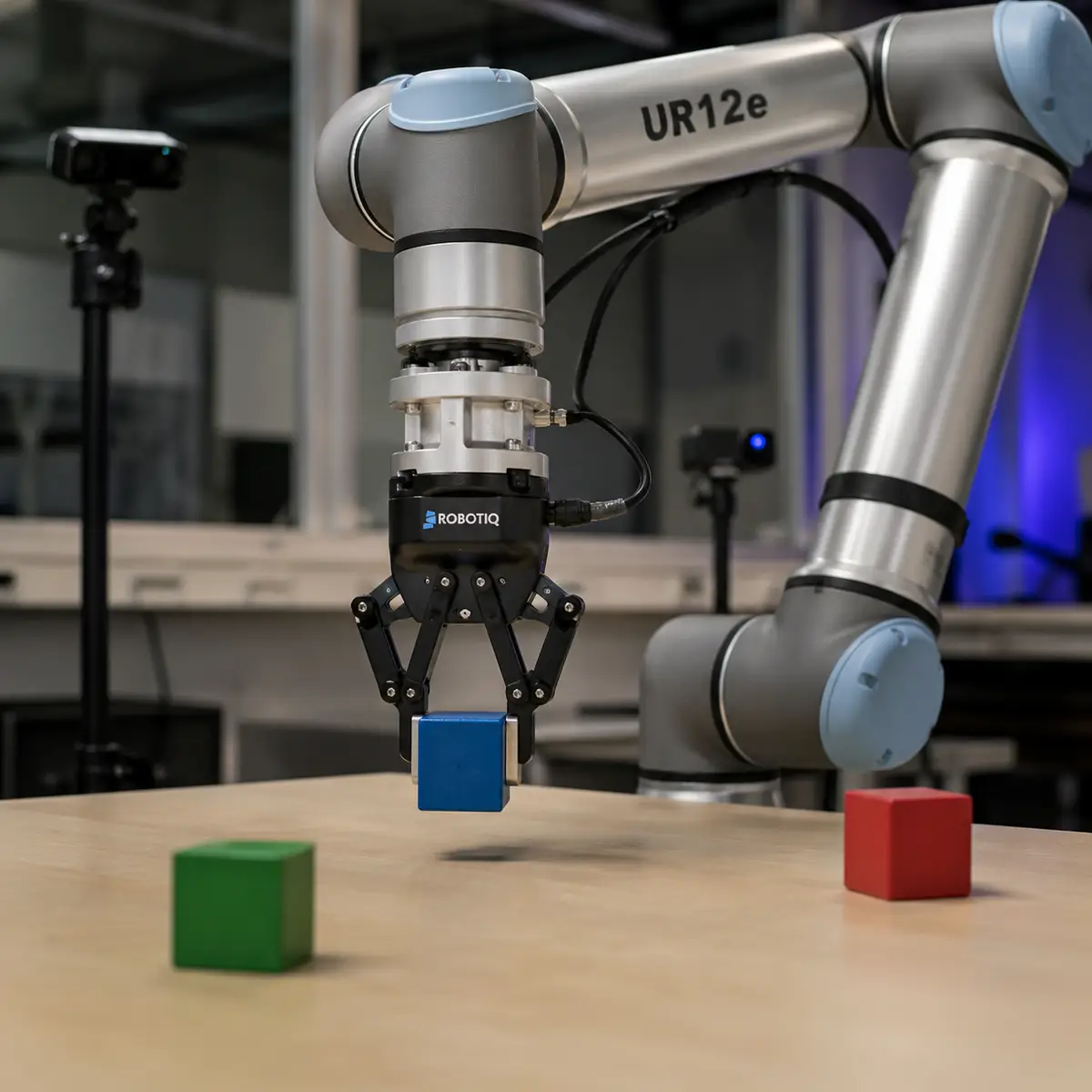
- End-to-End Control: A learned policy drives a UR12e robotic arm to approach and grasp the target.
The Technical Stack
- Dataset: ~290 teleoperated expert episodes.
- Perception: A three-camera array (top-down scene camera, gripper-mounted camera, and eye-tracking hardware).
- Policy Infrastructure: Trained Action Chunking Transformer (ACT), SmolVLA, and Diffusion-based policies orchestrated via the LeRobot framework.
- Interaction Paradigm: Zero manual menus or joystick control. Pure, direct: Look → Act.
Engineering Triumphs: What Worked Perfectly
In robotics, deploying end-to-end deep learning models on real hardware often introduces unpredictable failure modes across the entire stack. What we achieved with VisionGrip’s core navigation pipeline was highly stable:
The system successfully mapped user intent to spatial targets 100% of the time. Across all evaluation runs and trials, the robot reliably reached the exact target the user was looking at. This proved that:
- The gaze-to-spatial calibration pipeline was highly accurate.
- The model generalized perfectly to arbitrary object placements within the workspace.
- The real-time motion generation and trajectory scaling were fully solved from a systems engineering perspective.
The Generalization Challenge: Analyzing the Grasp Bottleneck
While targeting and approach achieved perfect reliability, executing the final grasp proved to be the ultimate stress-test for the policy. Under the exact camera geometry used during training, the robot achieved a 23% success rate on the final pick-and-place closure. However, when we introduced slight, real-world perturbations to the physical camera setup, grasp success dropped to 0%.
As an engineer, this failure mode was the most valuable data point of the project. It allowed us to diagnose a classic, subtle bottleneck in end-to-end imitation learning: implicit coordinate memorization.
[User Gaze] ──(100% Success)──> [Target Reached] ──(23% Success)──> [Successful Grasp]
│
(Introduced Camera Drift)
│
└───(0% Success)──> [Spatial Misalignment]
Because our initial policy operated directly on top-down camera coordinates without converting them into the robot's base frame, the model implicitly coupled manipulation skills with camera geometry. The robot wasn't failing to move; it was executing a perfectly memorized trajectory in a visual frame that had slightly shifted.
Uncovering this boundary condition is exactly what separates a lab demonstration from a production-ready assistive device. In the real world—especially in a home or on a wheelchair mount—you cannot assume a rigid, perfectly calibrated camera rig.
Productionizing the Architecture: Next Steps for Robustness
Identifying this constraint gave us a precise, actionable engineering roadmap to transition VisionGrip from a successful prototype to a resilient, real-world deployment. If I were scaling this system for production today, I would implement two architectural changes:
1. Viewpoint-Invariant Representation Learning
To decouple the policy from rigid camera fixtures, the perception stack must learn ego-invariant features. Incorporating frameworks like VISTA (View-Invariant Policy Learning via Zero-Shot Novel View Synthesis) would allow the system to normalize the visual input stream, ensuring stable manipulation even if the physical cameras drift or are re-mounted dynamically.
2. Object-Centric Conditioning
Instead of allowing the policy to treat the task as a geometric shortcut—"drive to pixel coordinate (x, y) and close"—the model should condition directly on semantic and visual features, such as segmentation masks or object embeddings. This forces the transformer to reason about the object's geometry and orientation relative to the gripper, rather than memorizing absolute spatial positions.
Key Takeaways
VisionGrip successfully demonstrated that gaze tracking can be paired with modern imitation learning architectures to build highly responsive, zero-menu assistive interfaces. Solving the intent-to-motion pipeline at a 100% success rate proved the viability of the user interface.
More importantly, the rigorous benchmarking and open-source datasets generated by this project highlight a mature engineering process: discovering hidden system assumptions early, identifying exact failure modes, and establishing a clear technical path toward spatial invariance and real-world generalization.
Open-Source Benchmarks & Artifacts
To support further research in gaze-driven manipulation and policy robustness, I have open-sourced our evaluation datasets on Hugging Face:
- Evaluation Datasets (Hugging Face):
frazier-z/eval_ur12_act— ACT baseline under matched camera geometry (23% grasp success).frazier-z/eval_ur12_act_v2— ACT performance under calibrated camera misalignment (0% grasp success).frazier-z/eval_ur12_smolvla— SmolVLA baseline evaluation.frazier-z/eval_ur12_diffusion— Diffusion Policy comparative analysis dataset.