
ShellDash - The AI Powered Delivery Machine
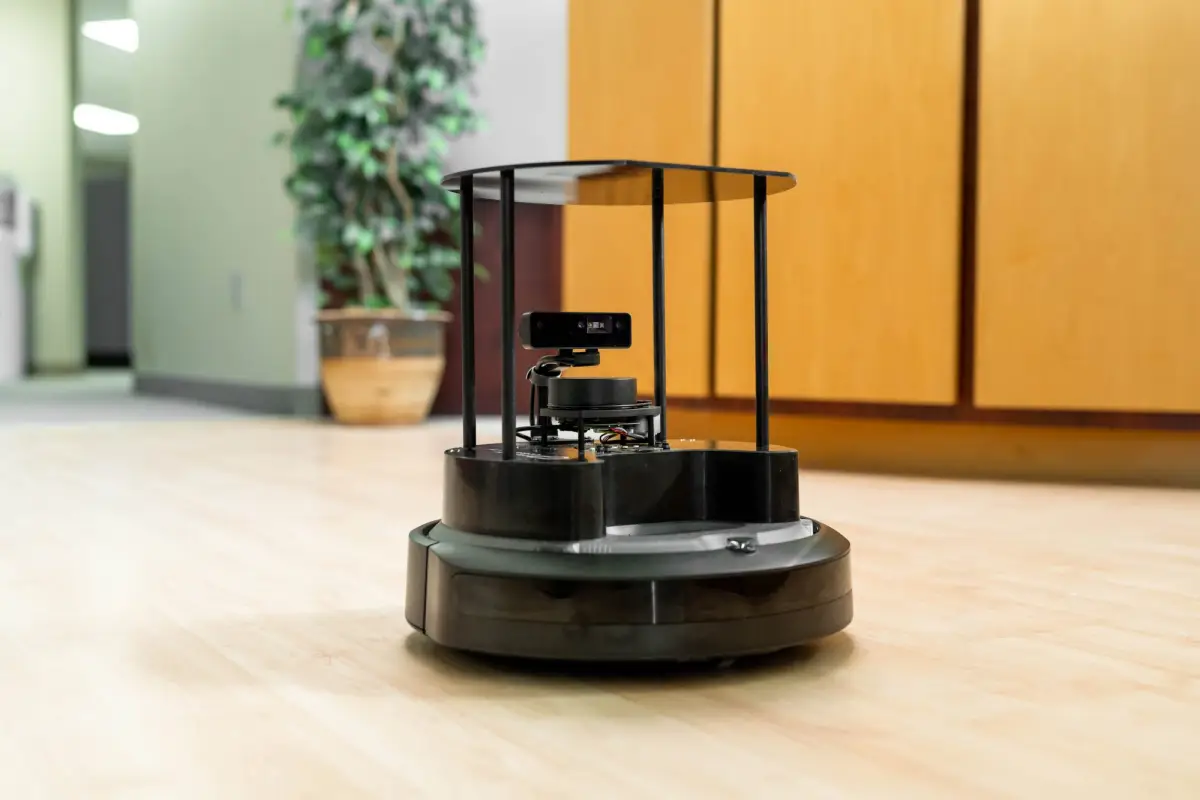
Written by Zackary Frazier, posted on
In my Robotic Sensing and Navigation Course capstone project, I had the opportunity to work on an exciting project that combines robotic sensing, navigation, and artificial intelligence (AI). The goal was to build a delivery machine called ShellDash, which can navigate through a mapped environment and deliver items to pre-specified locations. In this post, I'll walk you through my contributions to the project, including building the navigator node, integrating the complete system, and overcoming some of the challenges we faced.
Building the Navigator Node
One of the key components of ShellDash is the navigator node, which uses the Nav 2 algorithm to plan and execute navigation paths. I was responsible for implementing this component from scratch. The navigator node takes in a set of pre-mapped target locations and generates a sequence of commands to navigate through the environment.
To build the navigator node, we used a combination of ROS 2 topics and services. We created a nav service that would take in a navigation request and return a navigation response. This service was implemented using the Nav 2 algorithm, which uses a combination of SLAM, costmap, and motion planning to generate navigation paths.
Integrating the Complete System
Once we had built the navigator node, we needed to integrate it with the rest of the system. This involved creating a launch script that would start up the turtlebot, connect to the nav service, and trigger the navigation process using the voice module.
We also implemented a task management system that allowed us to publish task messages to the managed_task topic, which triggered specific actions in the system. For example, we could publish a "move" message to move the turtlebot towards a target location, or a "stop" message to stop the navigation process.
Overcoming Launch Script Challenges
One of the biggest challenges we faced was building a reliable launch script that could start up the entire system without errors. We tried several approaches, including using ROS 2's built-in support for launch files and services.
However, we soon realized that relying solely on ROS 2's built-in support wasn't enough. We needed to implement additional error handling and logging mechanisms to ensure that the system would recover from failures.
After experimenting with different approaches, we finally settled on a script that used a combination of ROS 2's launch command and some custom bash scripting to manage the startup process.
System Analysis
Once we had built and integrated the complete system, I was responsible for analyzing its performance. This involved designing an experiment to benchmark the reliability of ShellDash's navigation system.
We placed tape on the ground at known locations and commanded ShellDash to navigate to these locations one at a time. We measured the distance from the turtlebot's center to the target location using a tape measurer and observed any failures to navigate.
The results showed that ShellDash struggled to navigate in narrow spaces, which highlighted an opportunity for improvement. We also found that it may be more reliable to restart navigation when ShellDash spends too long on path-planning rather than letting it continue to path-plan.
Conclusion
In this post, I've walked you through my contributions to the ShellDash project, including building the navigator node, integrating the complete system, and overcoming some of the challenges we faced. The experience was invaluable, and I learned a lot about robotic sensing, navigation, and AI.
If you're interested in working on similar projects, I encourage you to experiment with ROS 2 and explore its capabilities. Don't be afraid to try new approaches and iterate on your design until you find something that works.
References
- ROS 2 (2020). ROS 2 Documentation
- SLAM Toolbox (2020). SLAM Toolbox Documentation
- Nav 2 (2020). Nav 2 Documentation
Artifacts
Video Demo